This perennial question does assume that the smart thing to do with intelligence is earn money, and to the extent that having money does free up your time, eventually, it could prove a good idea. However, if you sell all your time in exchange for money, putting off your thinking time, or your creative time, until you have 'enough', then maybe it doesn't seem such a good plan.
In the simple terms of IQ tests (whatever you think they actually measure) I score quite highly. I got a scholarship type pass to the 11+ exam (although that apparently had a bias towards boys), and on various self-testing scales I did pretty well (though such tests seem rather unreliable). When Test The Nation first happened I scored higher than anyone in the studio, and as high as the best on-line participant, but that test is not one recognised by MENSA, for instance. MENSA chooses people from the top 2% of the population, whichever test that gets measured by.
I only once met a group of MENSA members, and don't remember a particularly stimulating time, but I would not dismiss the possibility that not all members are too glum or serious for me. I appreciate that I might simply have been boring company for them. Who can tell?
I reckon I know quite a lot of smart people, particularly if we look at them through the filters of multiple types of intelligence (cf: Howard Gardner), a model which seems to correlate with the world far better, as those earlier tests do seem biased towards literacy and numeracy, in spite of a certain number of spatial awareness elements, and didn't appear to consider excellence in arts of sports (for instance), or maybe relationships, or the ability to communicate, as forms of intelligence.
Although I generally lean towards text-based learning myself (after decades of putting myself through the circus skills hoops, to encourage the other aspects of myself) I still veer away from books that sound like this:
"Despite the many specific disagreements that have marked the development of these theories of aesthetic and cultural postmodernism, their development has generally been contained within a horizon of consensus that has defined valid theories of postmodernism according to their deployment of methodological self-reflexivity, based (sometimes covertly) in the unconditional rejection of categories of totality, or totalization - a rejection that acts as a negative totalization itself."
This, from a professor of English - discussing the vivid and lucid writer William Burroughs, in "Wising Up The Marks" - a title that sounded sufficiently 'street' that I might find it amusing and enlightening.
No way could I study 'English' in such a context of abstractions and technical jargon (although I did find lighter patches in this book). That form of abstract, analytical study is what made Samuel Beckett sound unfunny, and Joyce 'difficult'.
The main problem for me, however, remains my dislike of tests. I don't like the experience of auditions, interviews, exams, tests or any of those events. Fear of failure, like everyone else (of course) plays a part in that - but also wanting to know who was so damned clever that they can set the tests.
Wednesday, April 17, 2013
Hard to fool a cat...
I love this movie.
I love Robert Altman, Elliott Gould, Raymond Chandler and the cynicism and world-weariness of film noir (and its deconstruction).
And I love the cat. Especially the gag about trying to fool the cat into thinking it was getting the right brand of food...
Note: though it is an extended stoner joke from 1973, it has one extremely unpleasantly violent moment.
How weird that Elliot Gould is now "the man from Ocean's Twelve", not "the man from the movie M*A*S*H" (long before the tv series).
I love Robert Altman, Elliott Gould, Raymond Chandler and the cynicism and world-weariness of film noir (and its deconstruction).
And I love the cat. Especially the gag about trying to fool the cat into thinking it was getting the right brand of food...
Note: though it is an extended stoner joke from 1973, it has one extremely unpleasantly violent moment.
How weird that Elliot Gould is now "the man from Ocean's Twelve", not "the man from the movie M*A*S*H" (long before the tv series).
Monday, March 04, 2013
Why is asking so hard?
I never felt comfortable with other people or society's rules. I thought I was surrounded by idiots. I couldn't even work out why I was on this planet. I didn't want a job, or property, or respect, or power, or privilege.
I immediately fell in love with the assorted Zen fools that I came across in the literature, and in Western culture the bohemians and tramps and others who simply did not share the values of those around them.
At the same time, I felt sad to be alienated, because when humans act kindly, they seem really great! I began to feel that in the 60s, when I also stopped feeling so alone, but that didn't really help me re-integrate with society, as I didn't display any musical or graphic talent that could be traded, for instance.
Street performing emerged from my defiantly spending my time on something I found interesting, and taking no heed for the practicalities of tomorrow. It was other people who spotted the potential, and started to offer trade-off payments in kind (food, shelter, lifts, clothing) in return for the entertainment value they perceived. I never managed to hustle my hat-passing, like some of the more efficient/proficient performers who came along later, and turned it into a real profession. I simply did my thing, and then told people that was all I did, and if they wanted to see me again, they could contribute, and that if they had no money I hoped they enjoyed it. And that's all. I have always been embarrassed to ask, and never could beg, for instance, I'd rather starve.
So everything in Amanda Fucking Palmer's wonderful TED talk rang bells for me, from the 'get a real job' jibes, to wondering whether I was somehow exploiting people and relationships, and whether it was fair to act 'as if the world owed me a living'. I went through all that angst, and it was only the warmth and reassurance of other people (the audiences and students) that convinced me I was genuinely earning my right to be here, to do play/work. And having regained my trust in people around me, other opportunities opened up. Please, especially if you are a creative person, give Amanda just under 15 minutes of your time.
I immediately fell in love with the assorted Zen fools that I came across in the literature, and in Western culture the bohemians and tramps and others who simply did not share the values of those around them.
At the same time, I felt sad to be alienated, because when humans act kindly, they seem really great! I began to feel that in the 60s, when I also stopped feeling so alone, but that didn't really help me re-integrate with society, as I didn't display any musical or graphic talent that could be traded, for instance.
Street performing emerged from my defiantly spending my time on something I found interesting, and taking no heed for the practicalities of tomorrow. It was other people who spotted the potential, and started to offer trade-off payments in kind (food, shelter, lifts, clothing) in return for the entertainment value they perceived. I never managed to hustle my hat-passing, like some of the more efficient/proficient performers who came along later, and turned it into a real profession. I simply did my thing, and then told people that was all I did, and if they wanted to see me again, they could contribute, and that if they had no money I hoped they enjoyed it. And that's all. I have always been embarrassed to ask, and never could beg, for instance, I'd rather starve.
So everything in Amanda Fucking Palmer's wonderful TED talk rang bells for me, from the 'get a real job' jibes, to wondering whether I was somehow exploiting people and relationships, and whether it was fair to act 'as if the world owed me a living'. I went through all that angst, and it was only the warmth and reassurance of other people (the audiences and students) that convinced me I was genuinely earning my right to be here, to do play/work. And having regained my trust in people around me, other opportunities opened up. Please, especially if you are a creative person, give Amanda just under 15 minutes of your time.
Monday, November 05, 2012
The Science of Magic
I saw an advert from Kenton Knepper, about some material he was offering on memory - and it was apparently stuff he prepared to show Psychology students at the University of Arizona.
Digging a little deeper, I found the course it was intended to be part of...
The Culture of Psychology and Magic
And that article on Randi's site, further pointed to Anthony Barnhart's website/blog
The Science of Magic
Where I found a link to an article by Teller, explaining how the principles of magic, field tested for centuries, can teach psychologists more than the inverse.
http://www.smithsonianmag.com/arts-culture/Teller-Reveals-His-Secrets.html
Digging a little deeper, I found the course it was intended to be part of...
The Culture of Psychology and Magic
And that article on Randi's site, further pointed to Anthony Barnhart's website/blog
The Science of Magic
Where I found a link to an article by Teller, explaining how the principles of magic, field tested for centuries, can teach psychologists more than the inverse.
http://www.smithsonianmag.com/arts-culture/Teller-Reveals-His-Secrets.html
Saturday, April 21, 2012
Testing, testing
Just experimenting with using Personal Brain to navigate my website - testing Home Page code in Blogger. If it works here, then I may put it in place on the old website... Personal Brain helps organise the pages, and to the left of each box you'll find a link that takes you to the actual page. I will add more content to the bottom part of the frame, bit by bit.
Wednesday, February 22, 2012
Living on Borrowed Time
As ever, John Lennon said it better than me (see post title and YouTube clip) - although I have managed to claw a few more years out of this lovely little planet, and the illusion of an individual life, than he did. Bless him.
This morning, I found myself in a snarl-off about the job I have now put 15 years into, because although it seems that my fellow workers know what I contribute, the people who actually pay me don't seem to value the role that highly. Hey ho. I am past retirement age, so I should probably just stop grovelling and quit.
I don't really care about pay-rates, but I like respect.
Since I dropped-out of school (when everyone said "you wouldn't dare leave, think of your future") and I just had to call their bluff (even if I starved, as they implied) I have had the same approach.
I remain a loyal and tireless worker for bosses who treat me with respect, but if someone implicitly threatens me with "think of how you would survive in the current economic climate" I just wanna go (I did that in the late 70s when the country was in crisis and someone thought they had the whip hand). I just walked away. I am still here.
But, if this sounds like a negative rant, imagine this. When we were filming The Dark Crystal we reached the end of the day (18:00h) and had not quite captured something we had all been working towards through the afternoon.
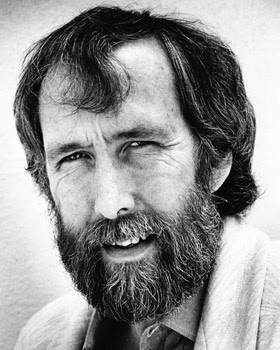 Now in the film business, if you go one minute over, all the unions claim another hour (at overtime rates). We were so close to getting the shot. Jim Henson announced that he couldn't afford overtime for 150 people, but he and Frank Oz wanted one more try at getting it in the can before we all went home. And, that's how beloved they were, as bosses, every person in that room turned a blind eye to their contracts, forgot their unions rules, and their tiredness and family obligations, and unanimously agreed to give it one more go, to get it right!
That's good management. That's working towards excellence with mutual respect. That was my first ever proper job working in a hierarchy (taking orders) - because of my previous 'bad attitude' to authority figures. I guess it spoiled me for the 'real world'.
RIP Jim, and thanks.
When I was younger
Living confusion and deep despair
When I was younger ah hah
Living illusion of freedom and power
When I was younger
Full of ideas and broken dreams (my friend)
When I was younger ah hah
Everything simple but not so clear
Living on borrowed time
Without a thought for tomorrow
Living on borrowed time
Without a thought for tomorrow
Now I am older
The more that I see the less that I know for sure
Now I am older ah hah
The future is brighter and now is the hour
Living on borrowed time
Without a thought for tomorrow
Living on borrowed time
Without a thought for tomorrow
Good to be older
Would not exchange a single day or a year
Good to be older ah hah
Less complications everything clear
Living on borrowed time
Without a thought for tomorrow
Living on borrowed time
Without a thought for tomorrow
"...all I've got to bother about is standing up..."
This morning, I found myself in a snarl-off about the job I have now put 15 years into, because although it seems that my fellow workers know what I contribute, the people who actually pay me don't seem to value the role that highly. Hey ho. I am past retirement age, so I should probably just stop grovelling and quit.
I don't really care about pay-rates, but I like respect.
Since I dropped-out of school (when everyone said "you wouldn't dare leave, think of your future") and I just had to call their bluff (even if I starved, as they implied) I have had the same approach.
I remain a loyal and tireless worker for bosses who treat me with respect, but if someone implicitly threatens me with "think of how you would survive in the current economic climate" I just wanna go (I did that in the late 70s when the country was in crisis and someone thought they had the whip hand). I just walked away. I am still here.
But, if this sounds like a negative rant, imagine this. When we were filming The Dark Crystal we reached the end of the day (18:00h) and had not quite captured something we had all been working towards through the afternoon.
 Now in the film business, if you go one minute over, all the unions claim another hour (at overtime rates). We were so close to getting the shot. Jim Henson announced that he couldn't afford overtime for 150 people, but he and Frank Oz wanted one more try at getting it in the can before we all went home. And, that's how beloved they were, as bosses, every person in that room turned a blind eye to their contracts, forgot their unions rules, and their tiredness and family obligations, and unanimously agreed to give it one more go, to get it right!
That's good management. That's working towards excellence with mutual respect. That was my first ever proper job working in a hierarchy (taking orders) - because of my previous 'bad attitude' to authority figures. I guess it spoiled me for the 'real world'.
RIP Jim, and thanks.
When I was younger
Living confusion and deep despair
When I was younger ah hah
Living illusion of freedom and power
When I was younger
Full of ideas and broken dreams (my friend)
When I was younger ah hah
Everything simple but not so clear
Living on borrowed time
Without a thought for tomorrow
Living on borrowed time
Without a thought for tomorrow
Now I am older
The more that I see the less that I know for sure
Now I am older ah hah
The future is brighter and now is the hour
Living on borrowed time
Without a thought for tomorrow
Living on borrowed time
Without a thought for tomorrow
Good to be older
Would not exchange a single day or a year
Good to be older ah hah
Less complications everything clear
Living on borrowed time
Without a thought for tomorrow
Living on borrowed time
Without a thought for tomorrow
"...all I've got to bother about is standing up..."
Monday, February 13, 2012
So far, so good.
Reasons to be cheerful:
And if you didn't get all those facts and figures, or wonder how accurate they are, this link takes you to a deadpan analysis of the details
This winter I decided to work on my old man archtype (I get bored with all this 'you don't look yer age stuff') but it doesn't involve much more than letting the beard grow out (that fools most people, for some reason).
- My birthday may still be associated with chocolate and cherubs, satin hearts and red balloons, sloppy romance and spending money - but at least it's a secular day now - all the religion squeezed out of it. I don't think the Church ever felt comfortable with Valentinus the Gnostic
- In 66 years I have travelled 38,504,400,000 miles round and round and round the sun, at 66,000 mph. And that doesn't allow for other movements (sun around the galaxy centre, etc)
- They didn't retire me yet, so I can still afford teeth, and shoes, and that sort of thing - before I fall into the black pit of the tiny pension
And if you didn't get all those facts and figures, or wonder how accurate they are, this link takes you to a deadpan analysis of the details
This winter I decided to work on my old man archtype (I get bored with all this 'you don't look yer age stuff')
 but it doesn't involve much more than letting the beard grow out (that fools most people, for some reason).
When George Burns was 93 he was at a party. It was after midnight and he had a whiskey in one hand and a cigar in the other. 
Somebody asked him "What does your doctor say about your lifestyle?" and he said "Oh he died long time ago."
Tuesday, January 10, 2012
MultiMedia and the Avant-Gardes
 I had to help write an essay about multimedia performances a few years ago, and found a wonderful book by Richard Kostelanetz which gave me a clue to how to shape the piece.
I have just bought it through AbeBooks for a very good price, as the Amazon going rate seemed much higher (£20-30 for the paperback).
Dictionary of the Avant-Gardes.
Mr Kostelanetz has written a myriad of fascinating material, and his website is definitely worth a visit.
Admittedly, I bought the first edition (1993) - the one that inspired me - and he has updated the second edition (2001) - with the cover shown here.
Indeed, he has offered some draft updates, should a third edition ever appear.
What I found, to help me shape the essay/thesis (with a deadline of a week!) was his reference to mixed-means theatre. He analysed the various forms that he covers with that term (Happenings, stage performances, kinetic environments, etc) using what I assume he got from Aristotle's rather rigid 'unities' for theatrical performances:
- The unity of action: a play should have one main action that it follows, with no or few subplots.
- The unity of place: a play should cover a single physical space and should not attempt to compress geography, nor should the stage represent more than one place.
- The unity of time: the action in a play should take place over no more than 24 hours.
 And that gave me all the structure I needed to help my friend shape his thesis. We simply worked through all the practical projects and shows he had done, and described them as involving:
- open or closed space
- fixed or variable time
- fixed or variable actions.
On top of all that, I love dictionaries, and this remains a treasure trove of cross-references, eye-openers, and other fun. He doesn't only cover some of my own favourite artists: Duchamp, Cage, Jarry, Joyce; but other perhaps less expected ones like Burroughs, Dylan and Bucky Fuller; and also genres from Performance Art to Punk Rock to Hypertext, and groups like Fluxus and Dada.
Thursday, December 15, 2011
Language as a virus
Reading The First Word: The Search for the Origins of Language - an overview on the current theories of language evolution - and felt very amused to find the model of language as a virus now having some currency among 'serious researchers' - given that the title of this blog comes from such a disreputable source as William S. Burroughs, based on his studies with Korzybski.
Perhaps his texts full of taboo subjects, grotesque and diseased images elicited an ugly association of the word 'virus' which hid the fact that he meant to indicate the method by which language appeared to replicate itself (something like what we now call 'memes').
You can find WSB discussing it in one of his less scary texts - The Job: interviews with William S. Burroughs - in the section called Playback from Eden to Watergate.

"My basic theory is that the written word was actually a virus that made the spoken word possible. The word has not been recognised as a virus because it has achieved a state of symbiosis with the host, though this symbiotic realationship is now breaking down, for reasons I will suggest later."
So anyway, without getting too technical, I flipped open p. 234 of the paperback edition of The First Word, to read:
"Kirby and a number of other researcers find one metaphor especiallly useful for thinking about language: imagine that it is a virus, a nonconscious life-form that evolves independently of the animals infected by it. Just as a standard virus adapts to survival in its physical environment, the language virus adapts to survival in its environment - a complicated landscape that includes the semi-linguistic mind of the infant, the individual mind of the speaking adult, and the collective mind of communicating humans.
According to Terence Deacon, language and its human host are parasitic upon each other. 'Modern humans need the language parasite in order to flourish and reproduce just as much as it needs humans to reproduce.' "
Indeed do artists get there first.
So anyway, Korzysbski had lots to say about 'language hygiene' (or thinking clearly) just as Burroughs adopted the cut-up method to reveal underlying assumptions, prejudices and styles.
Count Alfred Koyrzybski - a marginalized, ignored or forgotten person in the main - offered a set of tools for eliminating sources of error in thinking and speaking, which would have not made him popular with the kind of people who fund research, or politicians and leaders, or advertising execs, or religious types, or... Well, you get the idea. I happen to think he had a point, and quite a few of his tools have become adopted by people without awareness of the source (perhaps).
We use 'air quotes' for dubiously used words; many scientific studies now have started to merge with the use of the hyphen (neuro-linguistic studies, socio-biological) etc, etc. The whole area of study now called NLP (neuro-linguistic programming) - whatever your reaction to those words - remains a study of how words affect us and our belief systems, and how we might need to change the words we use to think about things, to produce real change in the world. And so does the movement called Political Correctness.
Symbolic Species: The Co-Evolution of Language and the Brain Terence Deacon
This review on Language Miniatures had a useful brief summary:
Copyright © 2001 by William Z. Shetter
"But is this perception really all that wide of the mark? Suppose we compare a language with something that really does have animate existence. Let's choose viruses:
“Silence is only frightening to people who are compulsively verbalizing.” AK
Too many words, too little time. In terms of 'mental hygiene', of course, most forms of meditation seem aimed at quietening the chattering monkey mind - because when that compulsive inner voice stops we might just catch a glimpse of the world...
“Modern man has lost the option of silence. Try halting sub-vocal speech. Try to achieve even ten seconds of inner silence. You will encounter a resisting organism that forces you to talk. That organism is the word. “ WSB
Perhaps his texts full of taboo subjects, grotesque and diseased images elicited an ugly association of the word 'virus' which hid the fact that he meant to indicate the method by which language appeared to replicate itself (something like what we now call 'memes').
You can find WSB discussing it in one of his less scary texts - The Job: interviews with William S. Burroughs - in the section called Playback from Eden to Watergate.

"My basic theory is that the written word was actually a virus that made the spoken word possible. The word has not been recognised as a virus because it has achieved a state of symbiosis with the host, though this symbiotic realationship is now breaking down, for reasons I will suggest later."
So anyway, without getting too technical, I flipped open p. 234 of the paperback edition of The First Word, to read:
"Kirby and a number of other researcers find one metaphor especiallly useful for thinking about language: imagine that it is a virus, a nonconscious life-form that evolves independently of the animals infected by it. Just as a standard virus adapts to survival in its physical environment, the language virus adapts to survival in its environment - a complicated landscape that includes the semi-linguistic mind of the infant, the individual mind of the speaking adult, and the collective mind of communicating humans.
According to Terence Deacon, language and its human host are parasitic upon each other. 'Modern humans need the language parasite in order to flourish and reproduce just as much as it needs humans to reproduce.' "
Indeed do artists get there first.
So anyway, Korzysbski had lots to say about 'language hygiene' (or thinking clearly) just as Burroughs adopted the cut-up method to reveal underlying assumptions, prejudices and styles.
Count Alfred Koyrzybski - a marginalized, ignored or forgotten person in the main - offered a set of tools for eliminating sources of error in thinking and speaking, which would have not made him popular with the kind of people who fund research, or politicians and leaders, or advertising execs, or religious types, or... Well, you get the idea. I happen to think he had a point, and quite a few of his tools have become adopted by people without awareness of the source (perhaps).
We use 'air quotes' for dubiously used words; many scientific studies now have started to merge with the use of the hyphen (neuro-linguistic studies, socio-biological) etc, etc. The whole area of study now called NLP (neuro-linguistic programming) - whatever your reaction to those words - remains a study of how words affect us and our belief systems, and how we might need to change the words we use to think about things, to produce real change in the world. And so does the movement called Political Correctness.
Symbolic Species: The Co-Evolution of Language and the Brain Terence Deacon
This review on Language Miniatures had a useful brief summary:
Copyright © 2001 by William Z. Shetter
"But is this perception really all that wide of the mark? Suppose we compare a language with something that really does have animate existence. Let's choose viruses:
- Like a virus, a language is an adaptive entity evolving with respect to its human hosts.
- Modern humans need this language parasite in order to flourish and reproduce.
- Humans ensure that languages, like viruses, are successfully replicated and passed on from host to host.
- The earlier the age at which a language or virus is acquired, the more success it will have (given the simple fact of human mortality) in reproducing from generation to generation. So language infects young children.
- Languages/viruses are highly organized and passed on as a complete, integrated working system, not as a collection of words/genes."
“Silence is only frightening to people who are compulsively verbalizing.” AK
Too many words, too little time. In terms of 'mental hygiene', of course, most forms of meditation seem aimed at quietening the chattering monkey mind - because when that compulsive inner voice stops we might just catch a glimpse of the world...
“Modern man has lost the option of silence. Try halting sub-vocal speech. Try to achieve even ten seconds of inner silence. You will encounter a resisting organism that forces you to talk. That organism is the word. “ WSB
Monday, December 12, 2011
Maps and Models and Meta-languages
I just read a quirky and entertaining book about maps and how they affect how we perceive the world around us - by a self-confessed "Map Addict"- Mike Parker.
It's an excellent read, and very stimulating to thought and further exploraration. He has a particular fondness for Ordnance Survey maps of the UK, but also covers local maps, rude street names, etc - and all the way out to world maps.
I felt sorry that in discussing world maps, where he pointed out the limitations of both the Mercator projection (with which we all feel familiar, in spite of its distortions of land size) and the Peters projection (which gets areas right, but appears downright ugly, and distorts the shapes of the landmasses - terribly PC and all that, but horrible). We traditionally draw these with The Atlantic in the middle, which emphasises the apparent importance of Europe and the USA, and with North at the 'top', which also has political implications. The Upside Down map created by someone from OZ certainly exercises the mind.
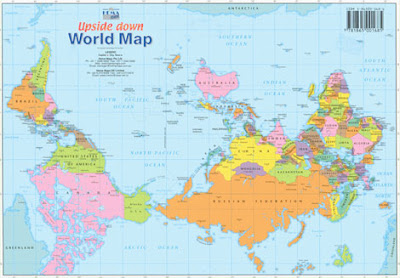
Of course, it perpetuates the misleading idea of 'up and down' which Bucky so disliked (in Cosmos you only find 'in' (coming in to land on a planet) and 'out' (he suggests you should think of looking out at the stars, not 'up').

Bucky Fuller's Dymaxion map may look very unfamiliar (and seeing things afresh might prove important in itself) but it does not distort landmass area or shape, it does not have any up or down, north, south, east or west, and it can actually be folded to make a good simulation of a globe (unlike any other flat map).
As Bucky disliked the idea of nation states, he preferred that his map of Spaceship Earth not get divided with national or political lines, and so, for all its value, it has not been adopted by the United Nations...or many people, indeed, who still prefer the misleading map they grew up with.
Similar discussions could follow, on how resistant we can all prove to any kind of change to the models and maps we use to simplify and understand the world. Changes in language can perhaps align us better with the world out there, as Bucky suggested (teaching your children about sunrise and sunset continues the incorrect perception of the sun going around the Earth, for instance, so he suggested sunsight and sunclipse...and how about 'going outstairs' and 'instairs'! :-)
Not sure if animated GIFs work in Blogger, so here you will find the link to bring this pic alive!

However weird some of his suggestions, they seem clearer than people in the Northern Hemisphere thinking of Australians as 'being upside down'. But hey, I don't hold my breath waiting for such quirky uses of language to catch on. Not until we have spent some time in space stations, at least.
Bucky artefacts at Artsy [updated Oct 2016]
It's an excellent read, and very stimulating to thought and further exploraration. He has a particular fondness for Ordnance Survey maps of the UK, but also covers local maps, rude street names, etc - and all the way out to world maps.
I felt sorry that in discussing world maps, where he pointed out the limitations of both the Mercator projection (with which we all feel familiar, in spite of its distortions of land size) and the Peters projection (which gets areas right, but appears downright ugly, and distorts the shapes of the landmasses - terribly PC and all that, but horrible). We traditionally draw these with The Atlantic in the middle, which emphasises the apparent importance of Europe and the USA, and with North at the 'top', which also has political implications. The Upside Down map created by someone from OZ certainly exercises the mind.

Of course, it perpetuates the misleading idea of 'up and down' which Bucky so disliked (in Cosmos you only find 'in' (coming in to land on a planet) and 'out' (he suggests you should think of looking out at the stars, not 'up').

Bucky Fuller's Dymaxion map may look very unfamiliar (and seeing things afresh might prove important in itself) but it does not distort landmass area or shape, it does not have any up or down, north, south, east or west, and it can actually be folded to make a good simulation of a globe (unlike any other flat map).
As Bucky disliked the idea of nation states, he preferred that his map of Spaceship Earth not get divided with national or political lines, and so, for all its value, it has not been adopted by the United Nations...or many people, indeed, who still prefer the misleading map they grew up with.
Similar discussions could follow, on how resistant we can all prove to any kind of change to the models and maps we use to simplify and understand the world. Changes in language can perhaps align us better with the world out there, as Bucky suggested (teaching your children about sunrise and sunset continues the incorrect perception of the sun going around the Earth, for instance, so he suggested sunsight and sunclipse...and how about 'going outstairs' and 'instairs'! :-)
Not sure if animated GIFs work in Blogger, so here you will find the link to bring this pic alive!


However weird some of his suggestions, they seem clearer than people in the Northern Hemisphere thinking of Australians as 'being upside down'. But hey, I don't hold my breath waiting for such quirky uses of language to catch on. Not until we have spent some time in space stations, at least.
Bucky artefacts at Artsy [updated Oct 2016]
Friday, October 21, 2011
Voodoo Economics
I am all for the various Occupy groups drawing attention to greed and corruption, etc - but I am still waiting to hear what solutions would satisfy them.
OK, taxing the rich, capping the maximum salaries, doing something about unearned bonuses, etc. Fair enough.
Unfortunately, as far as I can see, people have also maxed out their own credit, and seem to prefer the model of 'living well' - resisting the idea of frugality, tightening yer belt, rationing - sounds like 'socialism', maybe.
However, I still have confidence in Bucky Fuller's calculations that we already have enough resources for everyone to live comfortably and well, but the resources need redistribution.
Bill Hicks put it clearly:
I had a vision of a way we could have no enemies ever again, if you're interested in this. Anybody interested in hearing this? It's kind of an interesting theory, and all we have to do is make one decisive act and we can rid the world of all our enemies at once. Here's what we do. You know all that money we spend on nuclear weapons and defense every year? Trillions of dollars. Instead, if we spent that money feeding and clothing the poor of the world, which it would pay for many times over, not one human being excluded ... not one ... we could as one race explore inner and outer space together in peace, forever.
So I guess we need to tackle more than the money men. When I was a kid in the UK I thought it would have seemed like a great and bold move for the UK to unilaterally disarm, and join the small nations who do not spend huge sums on nuclear weapons that no-one was ever going to use. It took a couple of decades for the USSR to collapse. We spent unmentionable amounts of money making arms that would never ever get used - meanwhile dismantling the National Health Service and other great supports for all citizens.
The stupidity of all that still appals me.
I think we need something drastic. If we really did consist of 99% of the people, then the Permanent Universal Rent Strike would work. We all just stop paying mortgages and rent. What can do 'They' do, evict us all?
Then we have the Permanent Universal Tax Strike, until governments begin spending what they collect on the stuff we actually want.
Alternative currencies and LETS schemes, etc - trading skills and materials without them passing through money channels.
We might consider forgiving ourselves our debts, just as we write off Third World Debt. We just all declare ourselves bankrupt, and the debts unreclaimable.
Just riffing, you understand. I don't really expect 99% of the people to act together, sadly.
'They', the 1%, after all, carry on playing the 'print more money' model (in electronic versions) knowing full well that devalues what remains in circulation. They play at Voodoo Economics and convince us that money 'is' finite, resources are too limited, and all that.
[Update] Here's food for thought (thanks to Vincent for the alert): Revealed, the capitalist network that runs the world, from the New Scientist.
OK, taxing the rich, capping the maximum salaries, doing something about unearned bonuses, etc. Fair enough.
Unfortunately, as far as I can see, people have also maxed out their own credit, and seem to prefer the model of 'living well' - resisting the idea of frugality, tightening yer belt, rationing - sounds like 'socialism', maybe.
However, I still have confidence in Bucky Fuller's calculations that we already have enough resources for everyone to live comfortably and well, but the resources need redistribution.
Bill Hicks put it clearly:
I had a vision of a way we could have no enemies ever again, if you're interested in this. Anybody interested in hearing this? It's kind of an interesting theory, and all we have to do is make one decisive act and we can rid the world of all our enemies at once. Here's what we do. You know all that money we spend on nuclear weapons and defense every year? Trillions of dollars. Instead, if we spent that money feeding and clothing the poor of the world, which it would pay for many times over, not one human being excluded ... not one ... we could as one race explore inner and outer space together in peace, forever.
So I guess we need to tackle more than the money men. When I was a kid in the UK I thought it would have seemed like a great and bold move for the UK to unilaterally disarm, and join the small nations who do not spend huge sums on nuclear weapons that no-one was ever going to use. It took a couple of decades for the USSR to collapse. We spent unmentionable amounts of money making arms that would never ever get used - meanwhile dismantling the National Health Service and other great supports for all citizens.
The stupidity of all that still appals me.
I think we need something drastic. If we really did consist of 99% of the people, then the Permanent Universal Rent Strike would work. We all just stop paying mortgages and rent. What can do 'They' do, evict us all?
Then we have the Permanent Universal Tax Strike, until governments begin spending what they collect on the stuff we actually want.
Alternative currencies and LETS schemes, etc - trading skills and materials without them passing through money channels.
We might consider forgiving ourselves our debts, just as we write off Third World Debt. We just all declare ourselves bankrupt, and the debts unreclaimable.
Just riffing, you understand. I don't really expect 99% of the people to act together, sadly.
'They', the 1%, after all, carry on playing the 'print more money' model (in electronic versions) knowing full well that devalues what remains in circulation. They play at Voodoo Economics and convince us that money 'is' finite, resources are too limited, and all that.
[Update] Here's food for thought (thanks to Vincent for the alert): Revealed, the capitalist network that runs the world, from the New Scientist.
Monday, September 05, 2011
Pyramid selling
I have no idea how one goes about 'monetizing' a blog. Most of what I read sounds like pyramid schemes, multi-level marketing, chain letters, etc. Not something I want to get involved in.
I guess if I could find some content that I thought might actually appeal to a wider audience then I would feel OK about attempting it. I suspect my own interests remain too obscure.
One Point
Anyway, for now I decided to set up a new blog which would work as a nodal point for all my scattered material. I won't completely stop posting to the specialized ones, but I think it might be time for a new 'generalist' blog.
I have set up Time Piece (it may still change its name) as a place where I can have links out to all the old experiments, defunct blogs, bits and pieces scattered about - for my own convenience - and try out the new Blogger interface (who knew that Blogger had such a small share of the market place now?)
I guess if I could find some content that I thought might actually appeal to a wider audience then I would feel OK about attempting it. I suspect my own interests remain too obscure.
One Point
Anyway, for now I decided to set up a new blog which would work as a nodal point for all my scattered material. I won't completely stop posting to the specialized ones, but I think it might be time for a new 'generalist' blog.
I have set up Time Piece (it may still change its name) as a place where I can have links out to all the old experiments, defunct blogs, bits and pieces scattered about - for my own convenience - and try out the new Blogger interface (who knew that Blogger had such a small share of the market place now?)
Wednesday, July 20, 2011
Prurient interest
Can you imagine how the NoTW would have reported on this case?
It seemed odd to hear Rupert Murdoch proclaim his love of ‘investigative journalism’ when exactly that has exposed the flaws in the media he supported.
They’d probably have kicked off with asking how an ugly old rich man ends up with a beautiful, intelligent, feisty, oriental wife young enough to be his grand-daughter. They were proud of their campaigns against known paedophiles so they could surely not have resisted pointing out that he would have been about 50 when she reached puberty.
Don’t give me that “they love each other” crap. That wouldn't play.
I bet the NoTW didn’t say “leave them alone in peace” when John Lennon decided to divorce his English wife and marry an oriental woman older than himself.
Or when Woody Allen married his (much younger) oriental adopted daughter Soon-Yi Previn – which the NoTW could probably pitch to the prurient reader as both incest and paedophilia.
The bottom line for me, in my disgust at this situation, remains the hypocrisy of pandering to people’s lowest interests (because, yes, the people who regularly bought the paper do certainly have some responsibility in the matter).
The big difference to me remains the one between a panderer (the flatterer who tells people what they want to hear, without actually believing it themselves – a two-faced person) and someone with sincere, strongly-held, even if (to you and me) misguided beliefs. I have no desire to drag people into my value systems, so if you think Jesus lives on a flat earth (or voted Conservative) it has little interest to me.
What I seriously dislike remains the hypocrisy of pandering...writing invasive, unpleasant crap - low-brow, shit-stirring, gossip - and appealing to people’s lowest instincts, just to sell papers (get rich) and feel influential, while sneering (secretly) at how dumb your punters are.
In a free society (whatever that means) I think anyone retains the right to campaign for their strongly-held beliefs, even as part of a small minority...but to urge the crowd into hysterical mob behaviour and beliefs (while yourself not personally sharing those beliefs) still seems outrageous.
Friday, July 01, 2011
Passing the Hat
Covent Garden Hat Fairs in 1973-4


The queues outside the theatres and cinemas in London attracted street performers back in the 50s, mostly musicians, some dancers. A younger crowd started to appear, as the singer-songwriter thing started to happen in the early 60s - people like Don Partridge doing one-man band, Don Crown and his busking budgies, etc.

I don't quite know when the street life turned in the direction of magicians and jugglers and clowns. Myself, I had partied in the park in the late Sixties, but then went travelling for a couple of years. When I returned I had evolved a little comedy juggling and magic show, and quickly added some tumbling and slapstick, but there were no real venues for such a thing, and the street markets found me a little weird, so I was delighted when Mike Dean organised a community street festival in the embattled Covent Garden area, and negotiated with the authorities that anyone could (for the two days) arrive, put down a hat, and offer their act or display.
I was part of a commedia/clown troupe called The Raree Show, and we did quite a lot of community and street work, so we were comfortable with the idea. I also did my solo show, and (in the second year of The Covent Garden Hat Fair) a duo with Justin Case called Foolproof. It was an invitation to experiment.
In addition to music, you could have found crafts people, poets, and people like me starting out the trend to New Variety and New Circus. One of The Barrow Poets was there, and wrote a charming piece for the New Statesman, about the experience of taking part in this seminal event.
Hats in the Air
'The last week was lost a Merkin in the Coven-Garden,' reads a scurrilous little item in a 1660 news sheet. This week I saw not merkins, alas, but practically everything else was in evidence, as a vast assembly of people enjoyed a neighbourhood festival and hat fair to mark the gradual but inevitable extinction of Covent Garden. It was as a hat fair entertainer that I attended, a simple matter of performing free, and then collecting money in a hat. It's an exhilarating experience. My first taste of street busking came on Saturday, with a fellow Barrow poet, Susan Baker. We had planned some material; she had brought her violin, and I a topper decorated with balloons.
We wandered, lonely as a couple of clouds, in and out of the jazz bands and pop groups seeking a good site. There didn't seem to be one. Wherever we were, there always seemed to be some reason for not starting.
At last we diagnosed this reluctance as sheer terror, and dumped our gear on the pavement in James Street, where we stood. Susan tuned up and played a reel. When she had finished we had a crowd. I said a comic poem; we did a piece together, very jokey. They laughed. More jokes, more laughter. Bigger crowd. The adrenalin is going. Susan plays very boldly. I speak our as if addressing a large meeting. But it was getting too easy. So Susan played a Vivaldi movement. The crowd grew. I said Blake's London (How the chimney sweep's cry/Every blackening church appals). They listened, applauded. A Barrow colleague appeared down the street and spontaneously joined in.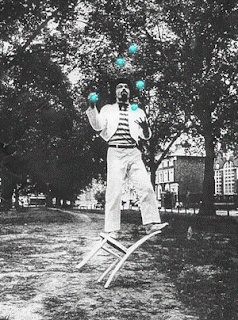
A few more pieces and we signed off and took the hat round. They paid and drifted off to find Toby, the acrobatic juggler, or my brother Julian Chagrin, doing his hilarious mime, or food, drink, the children's street, the belly dancer. Later, we did another street gig. I teamed up with my brother and did a two-man minishow with him, indoors. And in the evening the full Barrow team did a rumbustious programme at the White Swan in New Row.
By late evening megalomania had set in and I determined to make real an old fantasy of mine, and tell The Miller's Tale: in public, in full, and in the original. I arranged a pitch and a time and on Sunday afternoon carried my vast paperback to the King Street piazza. To my astonishment there were people there, waiting to hear it. I opened my book, introduced myself, and started. A drunk or drugged heckler inquired the colour of the miller's pubic hair. I told him red, and he drifted off, apparently satisfied. I read the story, and most of my smallish but gradually growing crowd stayed the full 40-minute course. Half way through, a band started up. I spoke louder, hammering out those magnificent words. The listeners crowded closer. The comic climax arrived, and yet again, Geoffrey Chaucer, deceased long before the birth of the now dying Covent Garden, made us laugh. The topper, now devoid of balloons, went round and supper was assured.
From then on events seemed to kaleidoscope. I did a one-man indoor programme, carried the hat for other performers, did a spot at a music hall, and was offered a pick through boxes of old theatre costumes, was given left-over food and booze to take home. I watched the organisers sweeping the streets, saw a member of Recreation Ground moving her motor-bike to allow space to a gigantic fruit lorry that crept like a fictional monster through the narrow streets.
Near midnight, I walked along Shaftesbury Avenue anachronistically attired in bell-bottom cords, 18th-century gentleman's jacket, and topper. Some French tourists asked me the way. A white balloon blew slowly past the shop fronts and lifted out into the traffic, breathtakingly avoiding destruction. As in a mirage a huge red bus came into view. And it was going my way! Gathering my packages I chased it, caught it at the lights and jumped aboard. The hat fair was over. But no. My neighbour spoke to me. 'Thought it was you. Glad you got on. Saw you doing your poetry. How was the White Swan? I'm in the theatre too. I do costumes.' She fingered my brocade sleeve. 'That's a lovely bit of cloth. Bet you didn't get that for nothing. Well, goodbye.' She got off. The festival was over.
© Gerard Benson 1974 New Statesman 13 September 1974


The queues outside the theatres and cinemas in London attracted street performers back in the 50s, mostly musicians, some dancers. A younger crowd started to appear, as the singer-songwriter thing started to happen in the early 60s - people like Don Partridge doing one-man band, Don Crown and his busking budgies, etc.

I don't quite know when the street life turned in the direction of magicians and jugglers and clowns. Myself, I had partied in the park in the late Sixties, but then went travelling for a couple of years. When I returned I had evolved a little comedy juggling and magic show, and quickly added some tumbling and slapstick, but there were no real venues for such a thing, and the street markets found me a little weird, so I was delighted when Mike Dean organised a community street festival in the embattled Covent Garden area, and negotiated with the authorities that anyone could (for the two days) arrive, put down a hat, and offer their act or display.
I was part of a commedia/clown troupe called The Raree Show, and we did quite a lot of community and street work, so we were comfortable with the idea. I also did my solo show, and (in the second year of The Covent Garden Hat Fair) a duo with Justin Case called Foolproof. It was an invitation to experiment.
In addition to music, you could have found crafts people, poets, and people like me starting out the trend to New Variety and New Circus. One of The Barrow Poets was there, and wrote a charming piece for the New Statesman, about the experience of taking part in this seminal event.
Hats in the Air
'The last week was lost a Merkin in the Coven-Garden,' reads a scurrilous little item in a 1660 news sheet. This week I saw not merkins, alas, but practically everything else was in evidence, as a vast assembly of people enjoyed a neighbourhood festival and hat fair to mark the gradual but inevitable extinction of Covent Garden. It was as a hat fair entertainer that I attended, a simple matter of performing free, and then collecting money in a hat. It's an exhilarating experience. My first taste of street busking came on Saturday, with a fellow Barrow poet, Susan Baker. We had planned some material; she had brought her violin, and I a topper decorated with balloons.

We wandered, lonely as a couple of clouds, in and out of the jazz bands and pop groups seeking a good site. There didn't seem to be one. Wherever we were, there always seemed to be some reason for not starting.
At last we diagnosed this reluctance as sheer terror, and dumped our gear on the pavement in James Street, where we stood. Susan tuned up and played a reel. When she had finished we had a crowd. I said a comic poem; we did a piece together, very jokey. They laughed. More jokes, more laughter. Bigger crowd. The adrenalin is going. Susan plays very boldly. I speak our as if addressing a large meeting. But it was getting too easy. So Susan played a Vivaldi movement. The crowd grew. I said Blake's London (How the chimney sweep's cry/Every blackening church appals). They listened, applauded. A Barrow colleague appeared down the street and spontaneously joined in.

A few more pieces and we signed off and took the hat round. They paid and drifted off to find Toby, the acrobatic juggler, or my brother Julian Chagrin, doing his hilarious mime, or food, drink, the children's street, the belly dancer. Later, we did another street gig. I teamed up with my brother and did a two-man minishow with him, indoors. And in the evening the full Barrow team did a rumbustious programme at the White Swan in New Row.
By late evening megalomania had set in and I determined to make real an old fantasy of mine, and tell The Miller's Tale: in public, in full, and in the original. I arranged a pitch and a time and on Sunday afternoon carried my vast paperback to the King Street piazza. To my astonishment there were people there, waiting to hear it. I opened my book, introduced myself, and started. A drunk or drugged heckler inquired the colour of the miller's pubic hair. I told him red, and he drifted off, apparently satisfied. I read the story, and most of my smallish but gradually growing crowd stayed the full 40-minute course. Half way through, a band started up. I spoke louder, hammering out those magnificent words. The listeners crowded closer. The comic climax arrived, and yet again, Geoffrey Chaucer, deceased long before the birth of the now dying Covent Garden, made us laugh. The topper, now devoid of balloons, went round and supper was assured.
From then on events seemed to kaleidoscope. I did a one-man indoor programme, carried the hat for other performers, did a spot at a music hall, and was offered a pick through boxes of old theatre costumes, was given left-over food and booze to take home. I watched the organisers sweeping the streets, saw a member of Recreation Ground moving her motor-bike to allow space to a gigantic fruit lorry that crept like a fictional monster through the narrow streets.
Near midnight, I walked along Shaftesbury Avenue anachronistically attired in bell-bottom cords, 18th-century gentleman's jacket, and topper. Some French tourists asked me the way. A white balloon blew slowly past the shop fronts and lifted out into the traffic, breathtakingly avoiding destruction. As in a mirage a huge red bus came into view. And it was going my way! Gathering my packages I chased it, caught it at the lights and jumped aboard. The hat fair was over. But no. My neighbour spoke to me. 'Thought it was you. Glad you got on. Saw you doing your poetry. How was the White Swan? I'm in the theatre too. I do costumes.' She fingered my brocade sleeve. 'That's a lovely bit of cloth. Bet you didn't get that for nothing. Well, goodbye.' She got off. The festival was over.
© Gerard Benson 1974 New Statesman 13 September 1974


Sunday, June 26, 2011
Sunday Morning

It is this morning.
We sit across the table from each other
breakfast over
the coffee steaming in the china mugs
as you read from the magazine
and I work on the crossword puzzle
sections of the news paper spread everywhere.
You look up, smile at me
and lean across the table for a kiss,
happy for no reason but it is Sunday,
we have all day to do with as we choose.
You are so sure of me
I am afraid enough for both of us.
In my life I never imagined
a morning like this morning;
the bed unmade
me in this ragged robe
all my senses singing:
This is what we share with one another.
This is the place I keep my promises.
Jaimes Alsop
Time Past
 The internet still surprises me. I went looking for some more of my old friend Jaimes Alsop's poems, as he doesn't appear to have collected them anywhere, and I found him writing on a board/forum about something I did all those decades ago!
"Years ago (late sixties) someone handed me a packet of Rizla cigarette papers (a popular brand in England). Inside was a folded cigarette paper on which was typed "Autumn Poem". When I unfolded the cigarette paper inside was the little slip that Rizla put in all the packets near the bottom as a warning the packet was getting low: "Only Five Leaves Left"
Thirty years later and I still smile over that one."

Of course, Nick Drake had also noticed that poetic phrase, and name his album Five Leaves Left.
When I returned to the UK (after a couple of years away) the little coloured slip popped up as I removed three cigarette papers. It read "Time to buy another packet" and I knew The Sixties were finally over.

Friday, June 24, 2011
Something to do with visions
 I had a good friend called Jaimes, in the mid-Sixties, who let me sleep on his sofa, inspired me with pranks and poetry, and made me laugh a lot.
It was the era of the singer/songwriter, and he was a poet, but he didn't make a living as a musician.
Later he went to the USA and a couple of years later, when I got my own adventure legs under me, I decided to drop in for coffee (in Palo Alto) without warning him I was on the way. He dealt with a hippie ghost turning up from a previous life really graciously, and again sheltered me until I got my second wind - then launched me out.
He just died a couple of days ago. We had made some internet contact in the last year or two, through his daughter.
I found this poem of his from 1969, in an old folder of writings...
Something to do with visions
It was something I had to tell you
Diane, it was all caught up with the morning
Something to do with visions
There were no visions today
I noticed particularly
There were no visions today, Diane
Perhaps they had all gone home
Today I was not deceived by your arteries
And though I searched your shoes and comb
I found no traces of gold
Even when I investigated my fingernails
There was no gold
Today love, you must have walked upon the ground
It was something to do with me
Today I was older than my generation
I refused to protect you from your virtue
There are too many, I said, too many already
in chains of flowers and April
They didn’t know about your perfume
They thought I was talking about seasons
It was something I had to tell you
I wrote it down so I wouldn’t forget
Something to do with visions
My eyes are rimmed with a fine and precious dust.
Monday, May 23, 2011
(May You Stay) Forever Young
 To wish His Bobness a happy 70th birthday seems more or less like holding up a lighter in a crowd of thousands. To get rid of the old shibboleth about his singing voice, if you don’t like it then just think of his records as rough demos sent in by a songwriter – for you to grab and interpret.
His back catalogue of about 450 songs must include something you like, even if you didn’t know he wrote it! Watch Ab Fab, and that ‘Wheels On Fire’ song (The Julie Driscoll version), for instance, or Jimi Hendrix pouncing on ‘All Along The Watchtower’.

At one time or another he plundered, enhanced, transformed and re-created most genres of American music – both the cool and the (at the time) uncool. From Rock to Blues, Country to Folk and Gospel (even Punk) he inspired just about everyone to re-investigate their roots, and then bring them into the NOW.
He encouraged The Beatles to give up pop music and cover versions and write their own stuff; his example must have helped The Stones get away from reproducing ‘old Blues Men’ and write modern blues; he made Johnny Cash cool; even his Christian ‘phase’ gave the gospel crew some great songs.
He broke the three minute song taboo; he created maybe the first video to go with a song.
In most tribute shows people still forage through the ‘folk era’ (with those great, timeless, mythical and archetypal images) and the social conscience songs of the ‘protest’ period. They miss the jokes. It’s hard to do jokes.
A notable exception (for me) was K T Tunstall, closing an otherwise rather mournful 'tribute show' with fresh, life-enhancing versions of the first two songs on Blood on the Tracks. (I'd have happily listened to her recreate the whole album!

Very few people seem to tackle his output of the last twenty years, even if he continues to write prolifically, and occasionally astound us with something unique that doesn’t belong to any of the previous music categories. Perhaps these songs are so personal that they work best through his unique delivery, his actor’s expressiveness, breath control and sense for story-telling – the words on the page often don’t capture his particular use of the voice and images.
Instead of vacuous love songs, cheating songs and breaking up songs, Dylan gave us a whole adult range of love and hurt and regret, bitterness, sadness, reconciliation, acceptance, and forgiveness. He expanded the vocabulary of song-writing.
But hey, if you still don’t like the voice (and he’s actually been through several styles) listen to some of the hundreds of cover versions, and you will find not just amazing words but great tunes. He can do stadium singalong anthems, or simple, cheerful versions, even of the same song – for instance, the two versions of Forever Young on ‘Planet Waves'. He famously doesn’t like sounding like the album, or even like last night’s live version, or doing too many takes in a studio. He remains a spontaneous performer, who likes surrounding himself with great musicians, and playing live.

His recent outing as a DJ on XM Radio, that the BBC bought for the UK (even if he was assisted by researchers) demonstrated the range of music he loves, appreciates and understands – as well as displaying his rueful and deadpan sense of humour (that so many people miss).
Happy birthday, Bob!
Thursday, May 12, 2011
Fossil Poetry

By virtue of this science the poet is the Namer, or Language-maker, naming things sometimes after their appearance, sometimes after their essence, and giving to every one its own name and not another's, thereby rejoicing the intellect, which delights in detachment or boundary.
The poets made all the words, and therefore language is the archives of history, and, if we must say it, a sort of tomb of the muses for, though the origin of most of our words is forgotten, each word was at a stroke of genius, and obtained currency, because for the moment it symbolizes the world to the first speaker and to the hearer.
The etymologist finds the deadest word to have been once a brilliant picture. Language is fossil poetry. As the limestone of the continent consists of infinite masses of the shells of animalcules, so language is made up of images, or tropes, which now, in their secondary use, have long ceased to remind us of their poetic origin. But the poet names the thing because he sees it, or comes one step nearer to it than any other. This expression, or naming, is not art, but a second nature, grown out of the first, as a leaf out of a tree.
What we call nature, is a certain self-regulated motion, or change; and nature does all things by her own hands, and does not leave another to baptise her, but baptises herself; and this through the metamorphosis again.
Ralph Waldo Emerson: Essays: Second Series [1844] The Poet
Thursday, April 07, 2011
Mind Maps, WebBrains, creative thinking...
A couple of years ago I took an online course studying to work as a Net Trainer. Like most qualifications I ever studied for, it has not proved directly relevant to anything I actually do to earn my bio-survival tickets and tokens.
Study does seem to stimulate the brain, though - and when the bodymind improves, the quality of life seems to improve, too. And, indirectly, most things I learn prove relevant in some way. So I have stumbled over the Personal Brain software, that I investigated back then, when looking at mind-mapping software. I couldn't work out if it was just a gimmick, or potentially so much more. It's certainly expensive once you move beyond the free personal brain trial level. Maybe it suits business models better?
Anyway, while procrastinating about writing, I work on projects - Beta Scrivener for Windows, learning Windows 7, looking back at my studies, getting into a Ning social networking and study group with some friends, collating my circus history stuff, using a free Wikispaces space.
And I reactivated the rather dull blog I created at the time of my Net Trainers study - when I was trying to deadpan the formal 'tutor' look. It really doesn't suit me very well, as my bohemian self seems to have emerged again as I turn retirement age and find my self playing Grandfather.
I have also taken a look at the old website, to see whether I should demolish it (it still serves a purpose) or give it a make-over. Currently just tweaking a few pages.
Study does seem to stimulate the brain, though - and when the bodymind improves, the quality of life seems to improve, too. And, indirectly, most things I learn prove relevant in some way. So I have stumbled over the Personal Brain software, that I investigated back then, when looking at mind-mapping software. I couldn't work out if it was just a gimmick, or potentially so much more. It's certainly expensive once you move beyond the free personal brain trial level. Maybe it suits business models better?
Anyway, while procrastinating about writing, I work on projects - Beta Scrivener for Windows, learning Windows 7, looking back at my studies, getting into a Ning social networking and study group with some friends, collating my circus history stuff, using a free Wikispaces space.
And I reactivated the rather dull blog I created at the time of my Net Trainers study - when I was trying to deadpan the formal 'tutor' look. It really doesn't suit me very well, as my bohemian self seems to have emerged again as I turn retirement age and find my self playing Grandfather.
I have also taken a look at the old website, to see whether I should demolish it (it still serves a purpose) or give it a make-over. Currently just tweaking a few pages.
Subscribe to:
Posts (Atom)
