Showing posts with label Anarchism. Show all posts

Tuesday, January 10, 2012

MultiMedia and the Avant-Gardes

I had to help write an essay about multimedia performances a few years ago, and found a wonderful book by Richard Kostelanetz which gave me a clue to how to shape the piece.

I have just bought it through AbeBooks for a very good price, as the Amazon going rate seemed much higher (£20-30 for the paperback).

Dictionary of the Avant-Gardes.

Mr Kostelanetz has written a myriad of fascinating material, and his website is definitely worth a visit.

Admittedly, I bought the first edition (1993) - the one that inspired me - and he has updated the second edition (2001) - with the cover shown here.
Indeed, he has offered some draft updates, should a third edition ever appear.

What I found, to help me shape the essay/thesis (with a deadline of a week!) was his reference to mixed-means theatre. He analysed the various forms that he covers with that term (Happenings, stage performances, kinetic environments, etc) using what I assume he got from Aristotle's rather rigid 'unities' for theatrical performances:


  • The unity of action: a play should have one main action that it follows, with no or few subplots.


  • The unity of place: a play should cover a single physical space and should not attempt to compress geography, nor should the stage represent more than one place.


  • The unity of time: the action in a play should take place over no more than 24 hours.
However, to describe the wider variety of audience, performer, creator interactions of mixed media / multimedia performance (including circus, in my terms) he offered this table:

And that gave me all the structure I needed to help my friend shape his thesis. We simply worked through all the practical projects and shows he had done, and described them as involving:


  • open or closed space


  • fixed or variable time


  • fixed or variable actions.
So I owe Mr Kostelanetz quite a bit (and the library for having a copy of his book available at the time).
On top of all that, I love dictionaries, and this remains a treasure trove of cross-references, eye-openers, and other fun. He doesn't only cover some of my own favourite artists: Duchamp, Cage, Jarry, Joyce; but other perhaps less expected ones like Burroughs, Dylan and Bucky Fuller; and also genres from Performance Art to Punk Rock to Hypertext, and groups like Fluxus and Dada.

Monday, August 17, 2009

What a Long Strange Trip it's been


I had real fun leaving work early on a Friday, to make my way (via 4 trains) to Stourbridge to see a genuine 60s hero working with a friend of mine. A showing of the movie TWENTY TO LIFE: THE LIFE & TIMES OF JOHN SINCLAIR (87-minute documentary film by Steve Gbehardt, 2007) then John Sinclair doing his poetry, and DJ Fly mixing musical accompaniment (although I bet that ain't the word for it these days).

Not only did I enjoy the gig itself, but had one of those smooth journeys, as though the universe wanted me to get there, nice and easy-like. The trains went on time, I met Nick outside the gig, we walked into town and bumped into Fly and Janne. After the gig I met up with Jack and Tony, and got whisked away to take tea and talk all night. A little sleep, more tea, then a ride into town on the extraordinary Hankmobile (thanks Hank!) a really fun way to travel, where I immediately met up with Fly and Janne again, then sat with Mr Sinclair for a short while, before strolling to pick up train connections (complete with a guard who advised me of a better route, saving me a couple of hours!) All very smooth. More on this later, gotta go back to work!

Check out John's new book, "It's All Good: a John Sinclair Reader".

His touring website - On The Road.

John's Wiki entry.

DJ Fly Agaric 23 on MySpace


Listen to John’s shows on
Radio Free Amsterdam


Episode #276 of the Radio Show (with DJ Fly Agaric) uploaded at SoundCloud

Fly on MySpace

Sunday, October 05, 2008

Home Made, Hand Made

I just watched Be Kind, Rewind - and enjoyed it. It may not be a classy film, it has a low budget look to it (stars and all) but the idea behind it seems cool.

Sweding - making your own stuff. In the world of Internet and YouTube almost everyone can get their hands on tools and stuff for their own creativity - you don't have to always buy 'corporate'. We all like quality, of course, but the 'punk' aesthetic of do-it-yerself has a lot going for it.
Panto at EPA Not that I consider the idea new. My dad made and used puppets throughout his life, with any old raw materials. A shortage of stuff after WWII made him ingenious about using anything that came to hand. His 'den' (where he ran workshops) had dozens of shoe boxes lining the shelves, with anything anyone chose to give him - cotton reels, toilet roll tubes, scraps of fabric, buttons, ping-pong balls, springs, etc.

He had a treasure trove of stuff. Like many artists he would sometimes seek out something to fit, but as often as not would allow the object itself to suggest a use.

The whole 'tv for kids' thing of making puppets with bits and pieces emerged from that work. After our extravagant and affluent wave, we have returned to the idea of recycling and reusing stuff - and getting creative on a budget.

I have nothing against people improving the quality of their product if the feedback of their creativity finds a big audience throwing money in the hat. I worked with Jim Henson at his peak, and that green sock and half ping-pongs that made Kermit had ended up with him able to employ whole teams of creatives, with access to the best tools and materials in the world. State-of-the-art experimentation. No problem. Employment for other creatives. Excellent!
35 years ago - living in a shed in someone's garden
I couldn't wait to get discovered, or pass an audition though - so I had started performing in the streets with what I had. It worked for me - through the thin times of the 70s - as punk emerged as yet another wave of 'homemade'. It doesn't have to look cheap - you can create style with attitude. I ended up in the movies for a while!

The NoFit State crew came out of a workshop I ran when on the dole (that £15 a week raised my income by a third!) No-one had any money. After 20 years of sweding, they now tour an award-winning show - tabĂș, with about 40 people on the road - getting reviews like this:

'Cirque Du Soleil without the Disney and the disinfectant… this is the future of British Circus.’- The Guardian

Tabu
Uploaded by nofitstate

Gee, gosh - it makes me proud - but they did it with whatever came to hand, lots of attitude and enthusiasm - and getting other people involved. Arts Councils didn't think of 'circus' as an 'art'. It's a lot of work, putting up and taking down your own theatre...


So - I have started making books for the same reason - because I can. Because anyone can get pen and paper (or access to a word processor). Because I don't have a video camera to make YouTube movies for my friends' amusement, (although I have put tiny clips up, I like to try everything). And because Lulu offer me the chance to actually make hard copies - like a book mocked up for a movie - see my Lulu storefront.
Cover by Bobby Campbell
I am sweding books right now. My mate Mick had only just started into computers when he died (in 1994) and he would have loved it. I started tidying the house, and really have to throw out all the books and papers of his that I hoarded...what I haven't made digital has to go. I already made up short runs of some of his writing back in the days of photocopying .

I now edited a final (?) version of 'the book that nobody could write' - Another Kinda Time by Mick Swain - (I leave you to decide if that is 'kinder' or 'kind of') - as one last tribute. He got me writing in the first place, and he might have loved the creative outlets in the modern world. You do this stuff for your own pleasure. If others take it up, amplify it, or put you in the spotlight, fine - but you should have fun, just in case you fail to give up the day job. Fun seems infectious, and gives you the best shot.

Oh, and just for a synchronicity (Mick's favourite model) the DVD extras include a 'mosaic of Passaic' (where they shot the movie with the help of local people). Just last night I used his own phrase to describe his method of turning diary writing into fiction - a mosaic of the prosaic. Spooky, huh?

And we now have hard copies of the Maybe Quarterly in circulation, too.

Michel Gondry's Be Kind Rewind on Director's File

Saturday, December 01, 2007

Don't Ask Me That!

Well, I finished my novel a couple of days early (hate chasing deadlines in a panic) but now the official ending has happened, and we can all celebrate and move on to editing, I guess, in NaNoFiMo (National Novel Finishing Month).

Actually, I want to use my momentum to write a shorter piece for Maybe Quarterly, so I may well put it aside for a while.

Why tell you this?

Well, people I have told basically ask me two questions. Friends ask “When can we read it?” and I tend to reply “Er, um, I dunno, I haven’t even proofread it for the stuff spell-checkers miss, I haven’t read it myself” and so on. Although I did send the draft to a couple of fellow conspirators, who may sample it, cut it up, etc. But as we work on collaborative multimedia productions, we don’t have many secrets from each other…

I wrote it fast, as part of NaNoWriMo, precisely to get past the internal censor and critic who so easily stops us doing anything – but that doesn’t mean I feel proud or confident about it, yet. I don’t feel ready for any criticism or feedback either, and I certainly don’t want any ‘supportive friends’ saying “how wonderful” just out of kindness.

The other question, from friends, colleagues, even strangers, I have no answer to.

“What’s it about?”

A killer question, to which I “er, um” even more. I mean – what’s life about, for goodness sake?

If people asked me what kind of book I tried to write I would say something like ‘a philosophical novel’ – no guns, no car chases, no sex – talking heads and minor adventures – think “Zen and the Art of Motorcycle Maintenance” or a movie like “Dinner With Andre”. (not that I’m comparing it to those, of course.) I couldn’t choose a NaNoWriMo genre, so elected for ‘other’.

E-Prime

Without going into to my Maybe Logic Academy training too much (which might make it sound like a cult, or something heh heh) one of the basic exercises we use to clarify thinking involves expressing ideas in E-Prime. This simply involves using English without the verb ‘to be’.

I really don’t have time to deal with any readers’ internal cries of outrage, right now, because we have discussed it long and hard, many times, at the MLA.

Some people say they can’t see how such a simple change would change the way you think, others say they couldn’t do without the verb (and invent ugly convoluted examples of language to prove the elegance of needing to continue to use the verb, etc), yet others ‘prove’ to their own satisfaction that the whole exercise seems pointless to them, and archly continue to use it, but with ‘quotes’ signalled in the air, to highlight their awareness (see the title of this blog, for instance), without having to make the effort to rephrase anything.

After getting accused of taking it all too seriously (an E-Prime Nazi) many of us MLA students have tended to settle back into E-Choice, i.e. slackly allowing ourselves to employ the verb in casual conversation or writing, and only bringing out this ‘thinking tool’ when the language conjures up ghosts, illusions and spooks - like "Is There A God?", for instance, or "Are the Beatles better than Beethoven?" - where re-phrasing can remove dispute, or at least clarify that we can only describe what we see and believe, not what 'is'. But I refer you to the literature and debate on the subject (s) elsewhere. In my humble opinion, the E-Prime tool works very well to remove pseudo-objectivity, and reminds the user that opinions and observations remain essentially subjective.

Robert Anton Wilson whole articles on this subject which form good intros,(and he wrote two books entirely in E-Prime, but you wouldn’t notice - I like this piece from Quantum Psychology), or check out the General Semantics website.

So anyway:

“What ‘is’ it about?” appears like a meaningless question to me, which makes it difficult to answer.

Re-phrased as “How would you describe it?” or “What subject did you want to tackle?” or “what kind of characters do you use?” or “What time period did you set it in?” or “Do you hope people will find it amusing, enlightening, cheering, depressing, sad?” or “which point of view did you use?” etc. I might come up with some answers.


  • I set it in the 1980s (before mobile phones and internet became widely available) .

  • I set it in Spain (a country I love, which contains colourful stuff for writing - paradoxical contrasts between authoritarianism and anarchy, charm and ruthlessness, etc)

  • I chose rootless and ‘on the road’ characters from several countries and cultural and religious backgrounds – outsiders, nomads, travelling players, artists, ‘gypsies’, immigrants, sailors, drug smugglers, etc. Some resemble me and my friends.

  • I tried to express the possibility that such diverse people can get on with each other, in contrast to ‘settlers’ and ‘land-grabbers’ who seem to spend a lot of time fighting over territory – oh, and hating, or at least distrusting, low-life 'nomads', who don't want the same things that they do.

  • I think of the south of Spain as the only part of Europe which didn’t spend two thousand years under Christian rule – and that, under Muslim rule, a period of time elapsed with relative tolerance. Tolerance among Muslims, Jews, Christians and Gitanos (Romany gypsies).

  • Astrolabe from 11th C.
  • Moorish Arabs brought all sorts of cultural benefits to our European civilization, which now seems air-brushed out of history, at least as it got taught to me. They translated the Greeks and Romans, worked with glass, chemistry, maths, astronomy, they encouraged learning, artists and scientists, etc. Their calligraphy also gave us the elegant and almost universal numerals - 1,2,3,4,5,6,7,8,9 - that work across language barriers.

  • alhambra tiles
  • I think of The Alhambra as a perfect example of elegance, in contrast to the bombastic and bullying Catholic architecture, with doors so big to make you feel small (I guess, unless they expect visits from angels and Gods) and filled with ugly and terrifying images of tortured humans. Islam does not allow portrayal of real beings, or idols, so their beautiful tilework seems modern to my eye. I find the geometric shapes filled with stars very pleasing, and the Arabesques of calligraphy and vines and leaves satisfy my 'Irish soul'.

  • By 1492 the Christians had not only destroyed the universities and libraries, but they drove the Muslims back to North Africa (or forced them to convert) suppressed Jews (equally in love with learning) and pushed Gitanos down to where they still find themselves even now – the lowest of the low – untouchables – Beneath The Underdog (to quote Charlie Mingus’ autobiog, a mongrel half-caste, himself). Oh, and they also went to grab America from the natives, of course, at the same time!

  • I only hint at that, as a sub-text, of course. And relate at least some of it to the Cathar tradition, too (the first genocide, enacted by ‘Catholic Christians’), in the Provence and Barcelona areas (which links back to troubadours, Sufis, and another period of spacetime in which a cultured and democratic system thrived for a while, with a certain independence for women, a love of learning, a genuine modesty and gentleness among the religious 'leaders', etc).

  • I am also aware that a period of culture like that relates to particular leaders, not to a religion. I have no desire to romanticise the Moorish culture. That modern radical Islamics like Al Quaida want to 'reconquer Spain' (considering it 'occupied Muslim land') just proves my point. Everyone rolls the movie back just far enough to justify their own claims to land...because the Moors arrived in 711 and left in 1492...so the previous owners also have a prior claim to the land in my eyes. When do we get the Visigoth resurgencel?
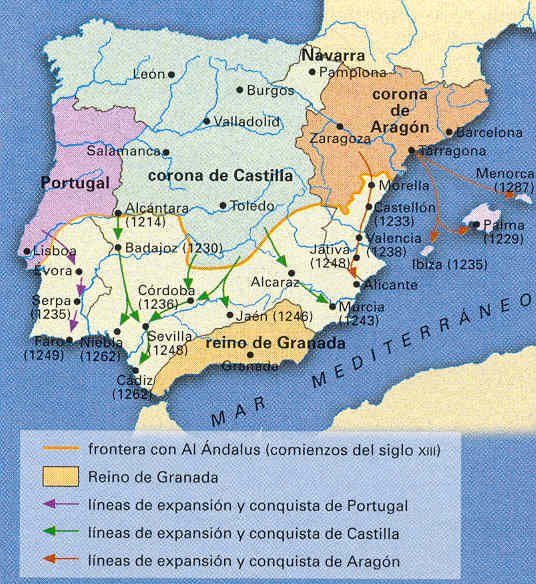
  • La Reconquista
  • Anyway - the Moors came in, then the Christians reconquered it, and now the Muslims want to reconquer it, and so it goes on. Hence my 'homeless and landless' characters...
  • An old anarchist atheist like me believes we won't get any real peace until we 'strangle the last lawyer with the entrails of the last priest' (I forget who said that) but those supposedly peace-loving religious people would probably want to stone me to death, or burn me at the stake, for that kind of attitude.
  • And I have nothing against individuals from these cultures - just the belief systems themselves, and the memes connected to them, which make me feel as though I live on the Planet of the Apes at times. That, of course, gets considered intellectual arrogance. So part of what I wanted to write involves the 'hatred of intelligence'...

Of course, by the time I’ve said all that I realise that my humble little book will need a lot more research and editing to tackle so many ambitious themes. And if you read this far, great! Most people wish they had never asked, or have fallen asleep by now, or glazed over at my ‘usual rants’.

I don’t know what it ‘is’ about…or to paraphrase somone (maybe Groucho?) “It is about fifty thousand words”.


For scale: you just read about 1600 words - roughly what I had to write each day.

Tuesday, November 27, 2007

Doggam, I did it!


I finished my 50000 word novel with three days to spare.


I actually hit 50050, as it seemed like a good idea at the time to hit 50/50, maybe.

Their word counter (after I scrambled it for their server) seems to think I did even more. Whatever.


It's called "Foolproof"


I have to thank my late (or parallel universe) friend Mick Swain, who would have loved this project.
Mick Swain - writer and mentor and best friend at the time
He loved writing and always encouraged me to try - no, not to try, but to actually DO it, and regularly, routinely, habitually.


Half way through, when I was losing momentum, he turned up as a character, 13 years and one month after he left this realm - he died on October 30th 1994 - to write his own happy ending at long last.


Thanks Mick! Here to Go!


As I rolled up to the finishing line, and gave him the last word, XM Radio was cranking out Leon Russell and Joe Cocker's "Mad Dogs and Englishmen" - and the track that hit by chance was "Space Captain"


Once I was travelling across the sky
This lovely planet caught my eye
And being curious I flew close by
And now I'm caught here
Until I die
Until we die
Learning to live together
Till we die
I lost my memory of where I've been
We all forgot that we could fly
Someday we'll all change into peaceful man
And we'll return into the sky
Until we die
Until we die
Learning to live together
Till we die
Live together, yeah,
Learning to live together
Till we die
Learning to live together
This involved a few late nights...
Till we die
Hum...Oh...
Ah... hum...
Until we die
Until we die
Learning to live together
To live together...
To live together...
To live together...


Friday, July 06, 2007

Leisure, writing and Disobedience

Replica of Thoreau's cabin
Having arrived back with a rant, I thought I would offer this in tranquility. On the right of the page you can see a link to Thoreau's Blog - an online project I really liked, as the guy had arranged to publish Thoreau's notebooks and diaries(including from his famous 'retreat' 1845-7) on a daily basis. Now the cycle has completed, he does not routinely update, so I'll just give you the sample for this date, back in 1840.

Thoreau's Journal: 06-Jul-1840
Have no mean hours, but be grateful for every hour, and accept what it brings. The reality will make any sincere record respectable. No day will have been wholly misspent, if one sincere, thoughtful page has been written.

Let the daily tide leave some deposit on these pages, as it leaves sand and shells on the shore. So much increase of terra firma. This may be a calendar of the ebbs and flows of the soul; and on these sheets as a beach, the waves may cast up pearls and seaweed.


I discovered Thoreau in my late teens, and hold him partly responsible for dropping-out, opting for a simple life, etc. Not just mystical nature retreats, either. You could try reading his 'Civil Disobedience' text which also influenced me.

A Word In Your Ear

I will spend a little more time back here in the blog, soon. I have decided to allocate the time I have spent in online study (for the last three years) in compiling my book. The website, of course, forms a kind of autobiography without much detail or inner thought, and my opinions get scattered throughout blogs, articles, emails, etc - but I like the idea of generating some sort of hard copy, probably using Lulu or some such 'on-demand' publishing scheme.

As usual, I may have an overspill of material, and may well use this space to ‘flex the writing muscles’ and warm up.

I don’t think I ever explained why I use the title I do, for this blog. If you know Burroughs’ work you may not need an explanation, but for me it relates to the fact that we use language to program our psyche-soma, and those hypnotic patterns literally confuse, bemuse or amuse us… The Neuro-Linguistic Programming guys analysed this years ago - although they have since developed a slightly cult feeling around NLP. The original linguistic analysis still holds true however, even if the magical claims - fast therapy, accelerated learning, etc - aspect may give you pause.

From today’s papers: “...for those who deny climate change: believe us, it’s a reality”.

You could spend the day dismantling that worthy thought. The implicit idea that climate has never changed before, the idea that you can either deny or ‘believe’ in such processes, rather than measure them. The sloppy use of the word ‘reality’, etc.

We as humans don’t intend to ‘save the planet’ (I don’t think cockroaches, rats, pigeons and micro-organisms will much care what we do to it, and feel sure Gaia doesn't mind) but we do want to save the planet as an inhabitable environment for humans. Not the same thing.
Kit Pedler
And if we really wanted to, or accepted that we have some responsibility for the way things have changed we wouldn’t just switch to washing our clothes at 30 degrees! Kit Pedler spelled all this stuff out years ago in The Quest for Gaia (1979) (and yes folks, the hippie generation saw it coming, too – remember Doomwatch in 1970?) – as well as washing at low temperature, you should quit ironing those clothes, quit shaving, quit driving, quit flying, quit eating meat, quit using deodorants, etc, etc. Of course, when Kit turned up at the Houses of Parliament, bearded, homemade woolly jumper, on his bike, no-one took him seriously. Hey ho. So it goes.

Rather similar language gets used for our bodily health as individuals. Giving up smoking doesn’t ‘save lives every year’. It may extend them, or decrease the discomfort of old age. It may also leave you lingering healthily and unhappily (and expensively for your children) when you could have gone out with a bang. Don’t get me wrong, I understand the point intended, I just wish the language would accurately reflect what they want, rather than try to manipulate me with emotion and half-truth.

And finally, in spite of Terrorism creating a certain amount of havoc, this ‘climate change’ seems to cause far more damage and expense, and if humans do take the blame then I guess compensation also seems reasonable. Until recently these kind of events counted as ‘Acts of God’ in insurance terms. Who causes more damage, fear, disruption and expense:- Terrorists or God? All together now….

Of course, if the concept of God drives you to distraction (language illusions again – and Dawkins specifically thinks of God as a word virus) you might enjoy Billy Connolly’s movie ‘The Man Who Sued God’ which plays with the idea of insurance firms (and churches) getting away with that.

Try Disaster maps on World Mapper

And if we do decide to hold humans responsible, after all, then we might look at figures like 984,000 people killed by cars (worldwide) in 2001.

That same year (and don’t forget that includes 9/11) the figures for terrorism

Total Persons Killed: 6318

You can see why I seem so wary of car-drivers, compared to Terrorists. They seem 200 times more likely to kill me!
Related Posts with Thumbnails